
My instinct told me that self storage should be a good business.
But instinct alone doesn’t pay the bills — or offset £2,000 per month in business rates and utilities on an empty building.
So I decided to dig into the facts.
Not glossy marketing brochures or industry hype — but the actual financial accounts of some of the biggest players in the market.
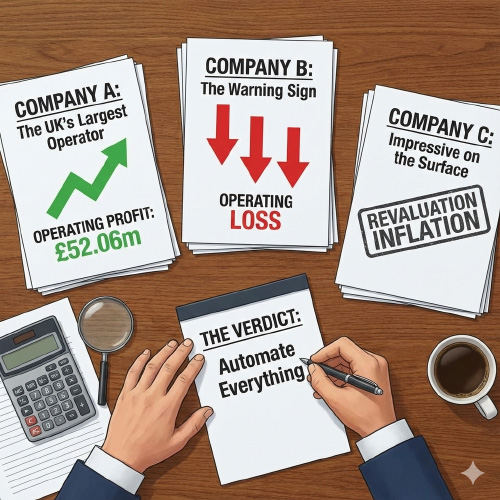
Company A — The UK’s Largest Operator
Company A proudly positions itself as the biggest self-storage brand in the UK. Their 2023–24 figures were striking:
- Turnover: £162.55m
- Operating Profit: £52.06m
- Total Assets: £376.87m
- Operating Margin: 32%
- Return on Assets (ROA): 13.8%
These numbers are not just good — they’re exceptional.
For context:
- GSK’s ROA: 10.2%
- Tesco’s ROA: 3.5%
- Shell’s ROA: 3.9%
If a self-storage company can outperform giants in pharmaceuticals, retail, and energy, then yes — self storage can be very profitable.
Company B — The Warning Sign
But I didn’t want to judge the industry by one star performer.
So I checked another operator — one that, coincidentally, has a site close to my Merit House property.
To my surprise, Company B swung into an operating lossin 2023–24, with falling revenue and rising costs. That made me nervous.
This was a company I had used personally in my early business days for seasonal and overflow stock — I knew they weren’t amateurs.
So how could a proven operator suddenly fall into the red?
Company C — Impressive on the Surface
For a third comparison, I looked at Company C, another national operator. Their 2024–25 figures:
- Revenue: £84.5m
- Operating Profit: £46.17m
- Total Assets: £1,615.8m
- Operating Margin: 54.6% (very impressive)
- Return on Assets: 2.9% (shockingly low)
A 54% operating margin paired with a 2.9% ROA didn’t make sense, so I dug deeper.
What I discovered was… interesting.
Company C revalues its buildings every year, resulting in a special profit item that is almost equal to its operating profit. Perfectly legal — but it inflates the numbers, making the business appear far more profitable than it really is.
Useful if you’re trying to raise fresh capital from the public markets? Definitely.
Helpful for long-term shareholders? Questionable.
A gift to HMRC? Absolutely — because revaluation gains are taxable.
The Verdict
The numbers told a clear story:
- Self storage can be a fantastic business when managed properly — Companies A and C demonstrate that.
- But it can also lose money, even for experienced operators — as Company B clearly shows.
One pattern stood out across all three companies: Costs are rising much faster than revenue.
And I can easily guess which costs are the core troublemakers:
- Rent — fixed once the site is chosen.
- Staff wages — and these rise every year.
Rent you can’t control. But staff costs… that’s where the battle is won or lost.
So the real question became: How do you keep staff costs to an absolute minimum?
The answer felt obvious:Use technology. Automate everything possible. Let staff be the last resort, not the first.
But that raised another question: Where exactly should I start?
Next Chapter: How Humanless Self Storage Works
to follow my BSS Journey — as I attempt to build a business where the lights stay on, but the staff don’t have to.
Leave a Reply