
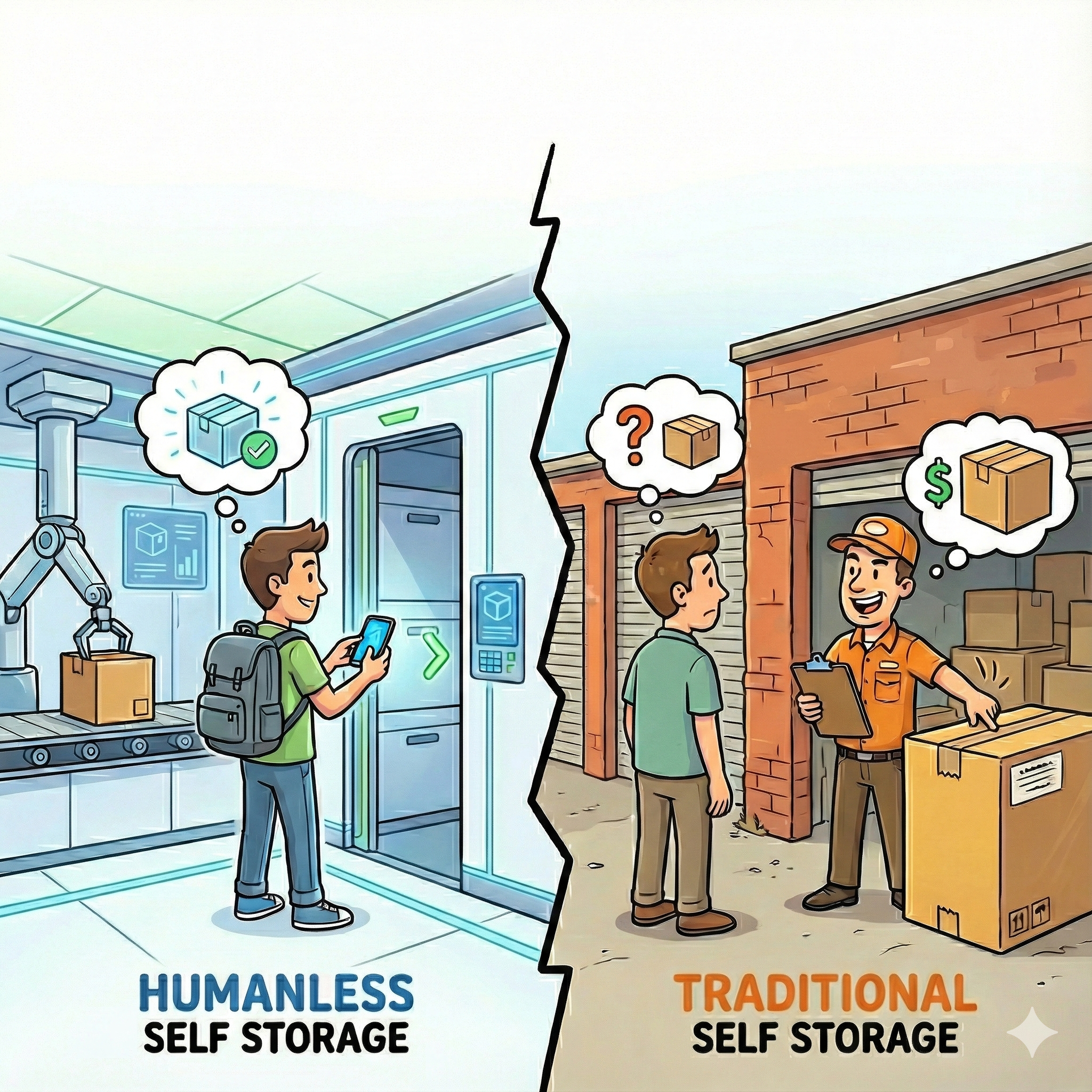
“Humanless” self storage doesn’t literally mean a warehouse with no staff at all. Some parts of the operation will always require human involvement — especially anything related to safety and responsibility.
For example, every new customer still needs a proper induction:
- Where the fire escape routes are
- How to use trolleys and lifting equipment
- Where to find the toilets and fire assembly point
- What to do in an emergency
These are things no app, chatbot, or fancy lock can replace.
But “humanless” does mean this:
The day-to-day operation should run smoothly without staff intervention.
The ideal customer flow looks something like this:
- Customers discover the facility online.
So the website — and the online presence — must be strong enough to attract them. - Customers check the available unit sizes and prices.
Which means the website must be transparent, clear, and helpful, allowing customers to make informed decisions without calling anyone. - They book a unit online, pay the deposit (if any) and first month’s rent, and sign the contract electronically.
Which requires a reliable payment system capable of automatically collecting monthly rent. - They enter the building with their access codes, as long as their rents are paid up to date.
Which means the software must talk directly to the access control hardware — enabling or disabling codes instantly based on payment status. - When they leave, automatically refunds their deposit (if applicable) and removes their access code.
Additionally, Lights should turn on when movement is detected and off when the building is empty.
In short, a humanless self-storage means customers can do everything without waiting for staff.
By contrast, the traditional model looks very different:

- They rely heavily on brand power and massive marketing budgets to encourage customers to phone in rather than book online.
- Staff create “tailored deals” for each customer, which sounds personalised but is actually a way to charge each customer the maximum they’re willing to pay.
- On first entry, customers queue up at the office, sign contracts in person, and wait for staff to guide them.
And because the staff are so busy answering phones and negotiating “special prices,” they often skip — or rush — the important parts of the induction. Many customers have no idea where the fire exits are or how to get help in an emergency.
Two Opposite Philosophies
In essence:
- Humanless Self Storage is built on the belief that customers know exactly what they need — and technology should empower them to do everything independently.
- Traditional Self Storage starts with the assumption that customers need to be “handled,” “guided,” and, ideally, upsold.
I know which of the two I prefer.
To automate a self-storage operation, the very first thing you need is a good management software. If the warehouse is the hardware, the management software is the operating system — like Windows transforms a dead metal box into a living, working computer. So the next big question became:
Which self storage management software should I choose?
Next Chapter: Which Self Storage Software?
free to follow my BSS Journey — where each step forward presents another maze of choices.
Leave a Reply