
After digging into the numbers in Chapter 11, one thing became painfully clear: if you want to survive in self storage, you need to automate as much as you reasonably can. Costs rise faster than revenue, and the only “flexible” cost you can truly control is staff time. So the question wasn’t whether I needed software — it was which one.
At first glance, the market looks full of options: Stora, 6Storage, Kinnovis, and plenty more. Most of them promise the same headline features:
- Billing and automated payments
- Customer and booking management
- Document management and e-signatures
- Gate/door access control
- Multi-site support
On a brochure, they all sound like they can run NASA. In real life, it’s usually more like trying to run a microwave with a broken door.
The “Perfect” WordPress Plugin That Didn’t Work
6Storage caught my attention for one simple reason: it was advertised as a WordPress plugin.
That was music to my ears. All my other websites are on WordPress, I know the system inside-out, and if I ever needed customisation, it’s easy to find expert freelancers who can deliver it in a cost-effective way. In my mind, it was going to be plug-and-play.
It wasn’t.
The plugin didn’t really work at all — and when I called the company, the answer was brutally simple:
“We don’t support the UK at the moment.”
So much for my shortcut. Back to the drawing board.
Stora: Popular, UK-Based… But a Problem I Couldn’t Ignore
Next, I looked at Stora. It has a strong reputation and plenty of positive feedback online, which usually means one thing: real operators are using it, and it mostly behaves itself.
It’s also UK-based — which instantly removes the “not supported in your country” surprise. And it supports API integration, which matters if you want to connect it to accounting, CRM, and anything else that stops your business turning into spreadsheet soup.
But there was one sticking point: access control.
The access control modules I saw felt outdated and rigid — the kind of “professional” system that comes with expensive hardware, expensive installation, expensive servicing… and still manages to annoy you daily.
It reminded me of something painfully familiar: the sliding gate at the industrial park where my furniture business operates. It’s faulty most of the time, and the service company always blames the residents:
“You’re not waiting for the gate to fully open before driving through.”
And they’re right. I’m not waiting. Who honestly has that kind of patience in 2025?
The real issue, though, was this: these rigid “commercial” access modules weren’t just old-fashioned — they were expensive, sometimes even more expensive than the storage software itself.
A Dangerous Thought: Can Consumer IoT Actually Be Better?
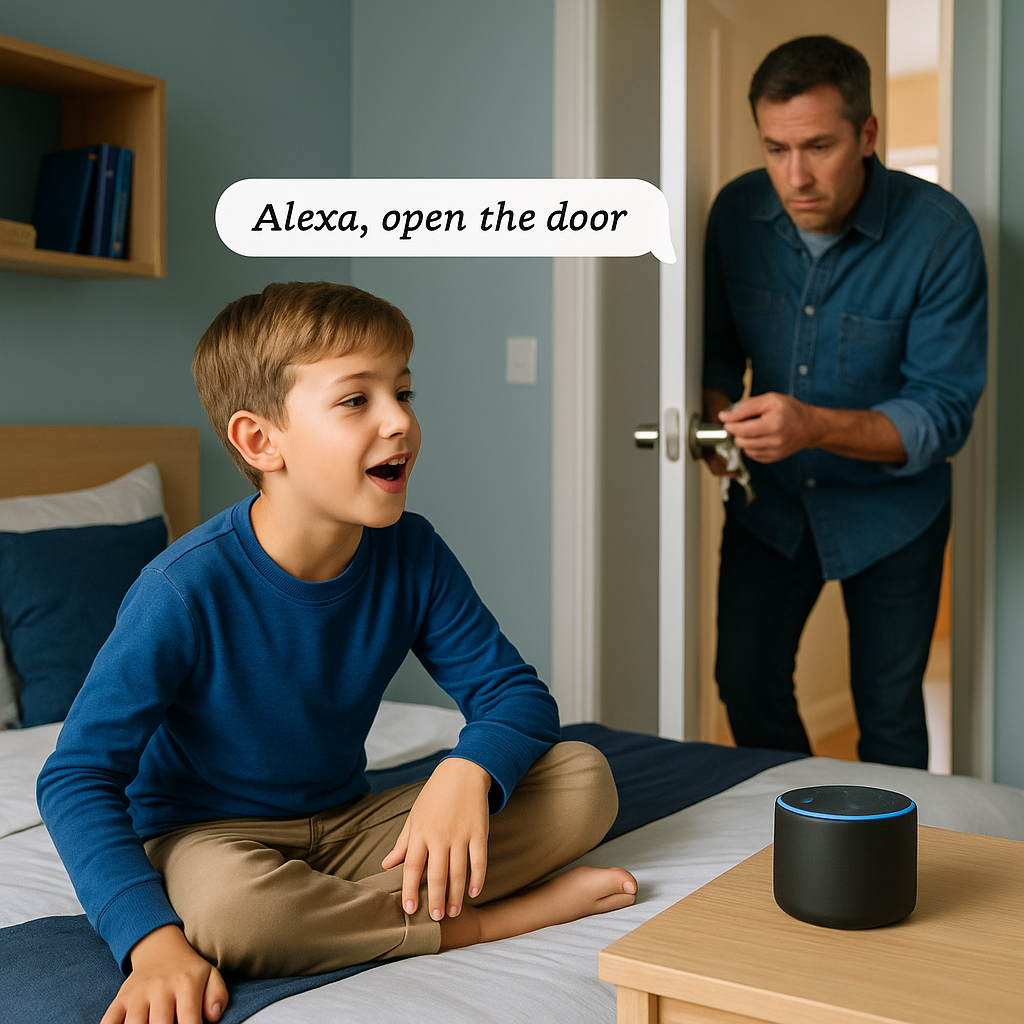
This is where my son Darren comes in. Darren is a proper IoT fan — smart locks, smart lights, smart sockets at home, all controllable through Alexa or an app.
And it got me thinking: consumer IoT products have a massive user base. Millions of homes. Constant feedback. Endless updates. Real-world stress-testing at scale.
Commercial access control systems may claim to be more robust — and perhaps they were 20 or 30 years ago when consumer IoT barely existed. But today? Their user base is tiny by comparison — maybe two or three orders of magnitude smaller.
So I started wondering: what if “consumer grade” isn’t inferior at all — just cheaper, more modern, and battle-tested in a different way?
The Catch: Software Needs to Control Access
Of course, there was a catch (there is always a catch).
To use consumer IoT hardware in a self storage facility, the management software must allow my script to:
- read billing/payment status
- link a customer to an access credential
- enable or disable access automatically
And most self storage software doesn’t really want you doing that. They’d prefer you buy their access control module and stay inside their ecosystem like a well-behaved customer.
Storeganise: Not Perfect, But Promising
That’s how I landed on Storeganise.
I couldn’t find clear public documentation confirming that access codes can be set or retrieved by external apps in exactly the way I imagined. But it does support custom fields, and it clearly states that all data can be accessed via API.
And that was enough for a spark of a plan.
The Plan That Looked Too Simple
In my head, it started forming like this:
- Use smart cameras to detect number plates or faces
- Or use a controller for fingerprint / RFID / NFC / PIN
- Link that identity to a customer account in the self storage software
- Then enable/disable access automatically based on payment status
It sounds almost embarrassingly simple when written down.
Which leads to the most uncomfortable question of all:
If it’s so simple… why hasn’t everyone done it already?
What hidden difficulties are waiting for me around the corner?
(And yes — the universe has a strong track record of answering that question.)
Next Chapter: Why “Simple” Access Control Isn’t Simple After All
free to follow my BSS Journey — where every “brilliant idea” eventually meets reality.
Leave a Reply