
Part 2: What Is a Tuya Developer Account? and Why Do I Need It?
After the embarrassing dinner incident in Chapter 20, I hesitated for a few more days. Eventually, I reached three conclusions.
First, enough was enough. I was not paying the freelancer another penny.
Second, finding another developer didn’t feel safe either. I didn’t even know what specific skills I needed, so I could easily fall into the same trap again — only with a different person and a fresh invoice.
Third, painful as it sounded, I probably had to dig into the problem myself. Not because I had suddenly become a software engineer, but because I needed to understand the scale of the challenge.
At that point, what I had was:
- An AWS virtual machine running a pile of JavaScript code I didn’t understand
- A Tuya Developer account full of connected devices I didn’t know how to control
A very modern problem, in other words: expensive, confusing, and entirely my own fault.
I asked a few friends and former classmates for advice. Some are IoT experts. Some are experienced software developers. But the real problem was this: I didn’t understand my own problem well enough to explain it clearly.
Because they were kindly giving me free advice, I was also conscious not to waste too much of their time. That created a slightly ridiculous situation: I asked vague questions, received vague answers, and became no less confused.
Then Darren stepped in.
He was only 13, but already far more comfortable with technology than I was. He had taught himself programming through YouTube and Roblox, and had even built a virtual airport hosted on my old laptop running Ubuntu.
When I explained the situation to him, he agreed to explore what we could actually do inside the Tuya Developer account.
That immediately removed half of my headache.
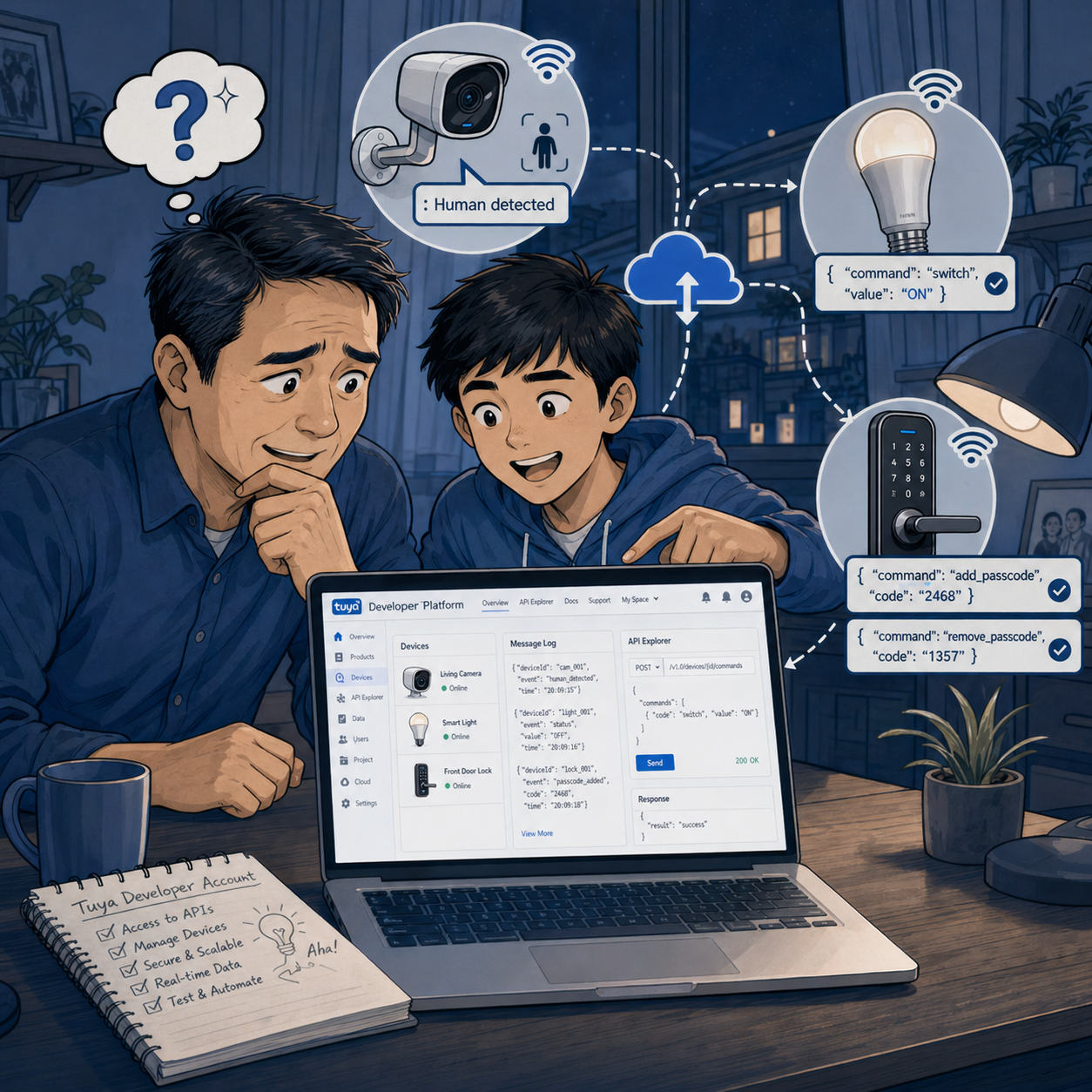
Darren quickly figured out that the Tuya Developer Platform was not really a place where you “build” automation in the simple way I had imagined. It was more like a testing and inspection centre. You could see what messages Tuya IoT devices were sending, and you could make test API calls to control them.
For example:
- What message does a camera send when it detects a human?
- What command turns a light on or off?
- What instruction tells a smart lock to add or remove an access code?
For me, this was a big breakthrough.
But understanding the platform was only the beginning. We could now see messages pouring in from our IoT devices. We could also send a test command to switch off a light or take a snapshot.
It was a bit like a primary school classroom. The children are whispering all the time. Every now and then, the teacher asks one pupil a question, tells another to sit down, and reminds a third to stop making noise.
Messy, but at least understandable.
Now imagine the teacher isn’t actually in the classroom. The teacher is trying to manage everyone remotely through Zoom.
That was closer to my situation.
The IoT devices are the pupils.
Tuya Sever is the classroom.
My system is the teacher.
But my “Zoom connection” didn’t exist yet.
I had to build it myself.
Next Chapter: The Broken Cloud Logic — Part 3: The Struggle with Tuya Encryption
free to follow my BSS journey — a real, unfiltered account of building an independent self-storage business in the UK, one problem, mistake, and hard-won solution at a time.
Leave a Reply