
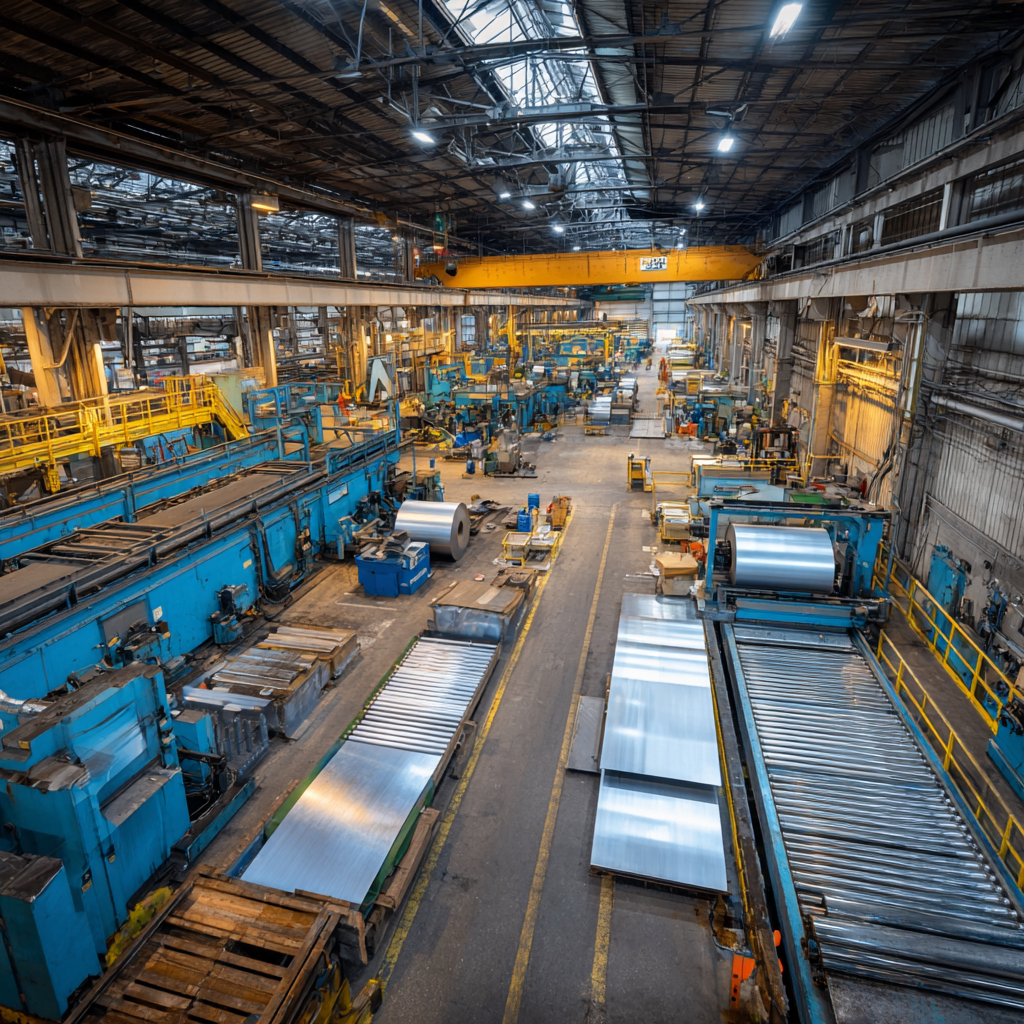
I’ve visited many factories over the years — some impressively large, filled with the rhythmic clanging of metal and the hum of production.
Our monitor arm supplier, for example, has about eight workshops, each roughly 40 by 100 metres. At the time, I thought that was big.
Then I visited the automated warehouse racking factories.
To put it mildly — they made everything else look like a garage project.
Imagine a hall wide enough for ten 40-foot container trucks to park side by side, and long enough to fit twenty more in a row. That’s just one workshop.
Rolled steel sheets fed into production lines filled with a series of enormous machines — shears, punch presses, stamping presses, welding robots, and sanders — each one transforming raw metal into perfectly shaped components. At the far end, a massive powder-coating booth gave every piece a crisp, durable finish.
It was like watching an orchestra of machines performing a piece I didn’t yet understand.
Then came the demo zones, where the real magic happened.
For the fully automated racking systems, everything worked like clockwork.
A pallet would arrive at a dedicated entry point fitted with Goods Lift, where sensors check its size and weight. Then, the system’s shuttles plotted a path, temporarily moving other pallets out of the way, the Goods lift will lift the pallet to the right level, and another shuttle will ferry the new pallet to its assigned BIN. Once in place, the system quietly returned the displaced pallets to their original spots.
Retrieval worked in reverse, except the pallet will come out from a dedicated exit point also fitted with Goods Lift.
But as I watched, one thing became clear: the planning behind BIN locations mattered immensely. Without it, the shuttles would spend half their time just rearranging pallets to make way for others.
If integrated with an inventory management system that could guide them intelligently, though, it could be a near-perfect operation.
The semi-automated system, on the other hand, was much simpler.
Here, both the first and last BIN locations can be entry and exit points. Forklifts will deposit or remove the pallet directly at those positions. From there, a shuttle transports it deeper into the rack, slotting it neatly into the farthest BIN, or retrieves the first pallet in its way.
Not as glamorous, but far simpler.
And with a little planning — like placing fast-selling products in the outermost slots, guided by consumption reports — it could work beautifully.
As our planned warehouse will be only 20,000 square feet, I couldn’t afford to lose pallet positions for “temporary” spots or entry/exit points & their goods lift. A semi-automated setup would do the job without wasting precious floor space, although I might have to face the forklift driver moaning too much time wasted on moving the pallets ON and OFF the racking.
It was a practical choice — and one that felt right.
Of course, practicality doesn’t always mean affordability. Traditional racking for 1,000 pallets can easily cost £100,000 or more. I estimated a semi-automated will cost 2 or 3 times more.
Then something unexpected happened which considerably reduced the cost, to a level even lower than that of a traditional racking system.
Next Chapter: The Unexpected Price War
to follow my BSS journey — where every challenge somehow turns into the next surprise.
Leave a Reply