
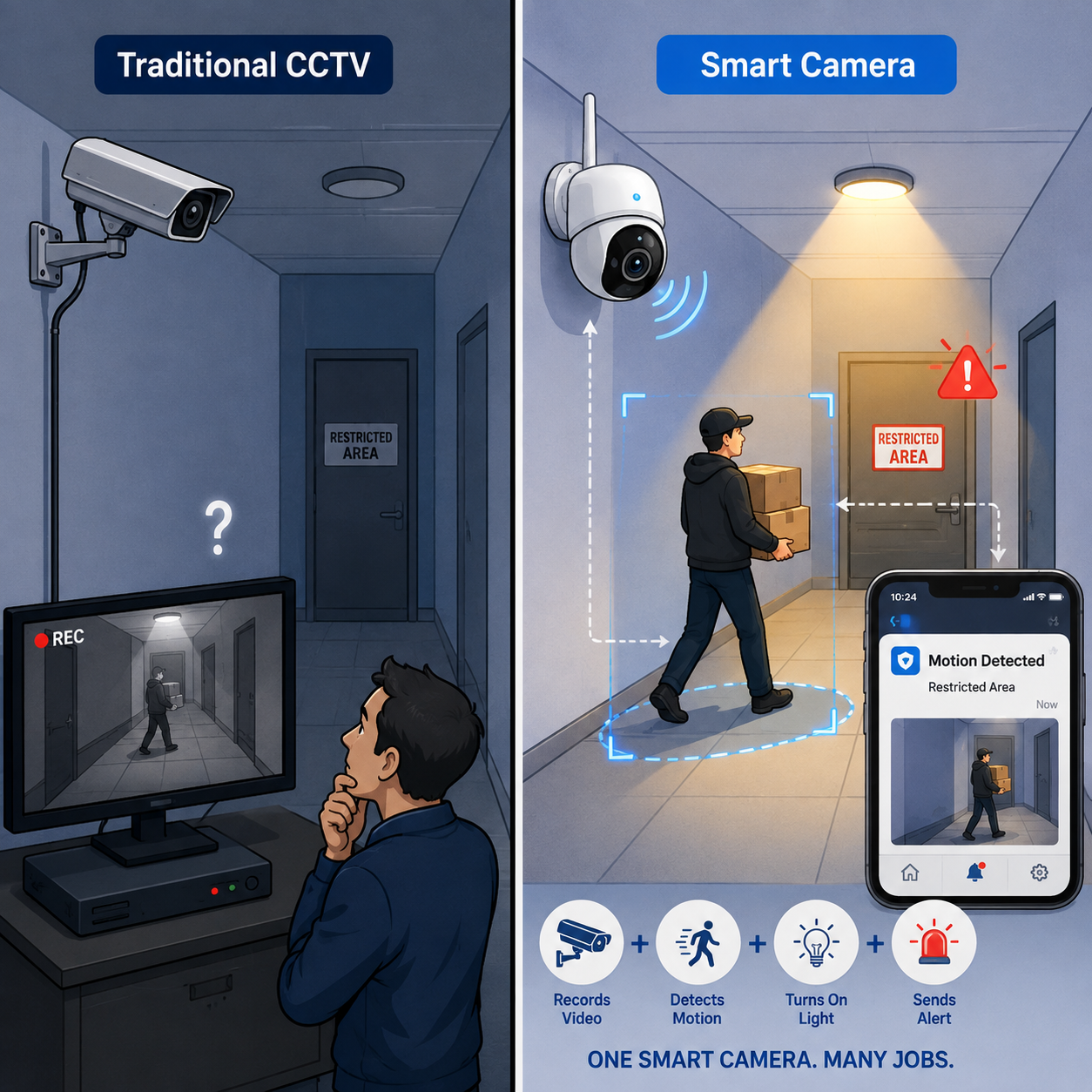
Smart Cameras: Killing Two Birds with One Stone
From the very beginning, I wanted our cameras to do two jobs:
- Record video
- Act as movement sensors
Traditional CCTV is very good at the first.
You can watch live video, record it, and play it back later. But trying to use the camera as part of a smart control system is much harder.
For example:
- If a camera detects a person, switch on the nearby light
- If a certain event happens, send a notification
- If movement is detected in a restricted area, trigger another action
Traditional CCTV is simply too rigid for that, and smart cameras are the only choice.
Which Smart Camera: Tuya or Tapo?
Choosing Tapo cameras was not a casual decision.
By this stage, I had already spent hundreds of hours learning the Tuya ecosystem — from the Tuya Developer Platform to Pulsar messaging.
My home demo setup was completely Tuya:
- smart lock
- smart light switch
- smart camera
- presence sensor
Emotionally, moving away from Tuya was difficult.
It felt a little like admitting:
I made a foolish mistake, and all those hundreds of hours were wasted.
So why even consider Tapo?
It started when I wanted a third camera to test the Network Video Recorder.
The exact Tuya camera I had bought only six months earlier was already unavailable.
The reason was simple.
Tuya does not manufacture any hardware itself. It provides the platform and technology to a large number of OEM manufacturers. Many of those manufacturers are relatively small, and their models can appear and disappear very quickly.
That inconsistency may be fine for home gadgets.
For commercial use, where you want the same hardware to remain available for years, it made me nervous.
Why Tapo Cameras?
While searching for alternatives, one name kept appearing: Tapo.
The Tapo cameras are widely available and some models like the Tapo C100 is surprisingly cheap, roughly 1/3 of the Tuya camera I used in my home demo setup.
Then I remembered something: Darren already had one.
He had been using a Tapo camera to watch our budgies remotely while we were on holiday.
More importantly, I discovered that Tapo is a brand of TP-Link — the company best known for broadband routers and networking equipment.
That immediately gave me much more confidence.
For over two decades, I had used many TP-Link routers. I honestly cannot remember one failing. They normally became obsolete because broadband speeds moved on, not because the hardware died.
That was exactly the kind of reliability I wanted.
Life’s Pleasant Surprise
Still, one question bothered me: Should I spend another few hundred hours learning a completely different ecosystem?
This time, rather than usual setbacks, life gave me a pleasant surprise: Most of what I had learned from Tuya was still useful.
There was no Tapo Developer Platform, no messaging, no encryption/ decryption, not even API calls, all I needed was the Tapo app, a Camera Account, and the camera’s local IP address.
With those, I could connect Tapo cameras into the access-control system hosted on AWS, or the lighting-control system running on my local Ubuntu server.
Suddenly, all those painful hours learning Tuya did not feel wasted after all.
Another Lighting Challenge
In my home demo project, the Tapo cameras worked just as well as the Tuya ones. But when we moved to the real self-storage site, the number of cameras increased by roughly ten times, and a strange problem appeared.
They would connect.
A few got disconnected.
Some got reconnected, while a few others got disconnected …
For a humanless self-storage facility, it is a nightmare.
If a camera is responsible for detecting movement and triggering lights, then a disconnected camera means: No event.
And no event means: No light.
Which put us straight back to the lighting problem I thought I had already solved — customers potentially walking into darkness.
But this time, I genuinely had no obvious answer.
Should I switch back to Tuya? Should I start testing yet another camera brand? Or was there a way to fix the Tapo cameras themselves?
Next Chapter: My First Git
free to follow my BSS journey — a real, unfiltered account of building an independent self-storage business in the UK, one problem, mistake, and hard-won solution at a time.
Leave a Reply